

Description
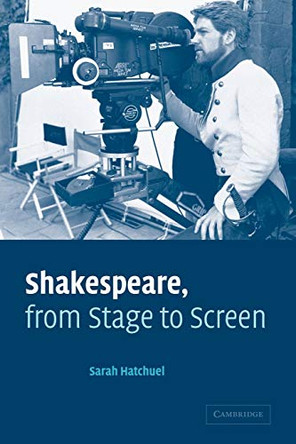
How is a Shakespearean play transformed when it is directed for the screen? In this 2004 book, Sarah Hatchuel uses literary criticism, narratology, performance history, psychoanalysis and semiotics to analyse how the plays are fundamentally altered in their screen versions. She identifies distinct strategies chosen by film directors to appropriate the plays. Instead of providing just play-by-play or film-by-film analyses, the book addresses the main issues of theatre/film aesthetics, making such theories and concepts accessible before applying them to practical cases. Her book also offers guidelines for the study of sequences in Shakespearean adaptations and includes examples from all the major films from the 1899 King John, through the adaptations by Olivier, Welles and Branagh, to Taymor's 2000 Titus and beyond. This book is aimed at scholars, teachers and students of Shakespeare and film studies, providing a clear and logical apparatus with which to examine Shakespearean screen adaptations.
In this 2004 book, Sarah Hatchuel analyses how Shakespearean plays are transformed when they are directed for the screen.
About the Author
Sarah Hatchuel is Lecturer in English at the University of Paris I Pantheon-Sorbonne and Teaching Assistant in Film Studies at the University of Paris VII. She is the author of A Companion to the Shakespearean Films of Kenneth Branagh (2000) and has published several articles on the aesthetics of Shakespeare on screen.
Reviews
"[A] good survey of Shakespeare on stage, from the Globe to the Restoration to Drury Lane and 19th-century realism to cinema." J.M. Welsh, Salisbury University, CHOICE
Book Information
ISBN 9780521836241
Author Sarah Hatchuel
Format Hardback
Page Count 202
Imprint Cambridge University Press
Publisher Cambridge University Press
Weight(grams) 470g
Dimensions(mm) 229mm * 152mm * 16mm
In this 2004 book, Sarah Hatchuel analyses how Shakespearean plays are transformed when they are directed for the screen.
About the Author
Sarah Hatchuel is Lecturer in English at the University of Paris I Pantheon-Sorbonne and Teaching Assistant in Film Studies at the University of Paris VII. She is the author of A Companion to the Shakespearean Films of Kenneth Branagh (2000) and has published several articles on the aesthetics of Shakespeare on screen.
Reviews
"[A] good survey of Shakespeare on stage, from the Globe to the Restoration to Drury Lane and 19th-century realism to cinema." J.M. Welsh, Salisbury University, CHOICE
Book Information
ISBN 9780521836241
Author Sarah Hatchuel
Format Hardback
Page Count 202
Imprint Cambridge University Press
Publisher Cambridge University Press
Weight(grams) 470g
Dimensions(mm) 229mm * 152mm * 16mm